Turning Living Biology into Answers for the Age of AI
.png)

AI accelerates discovery of new medicines when it learns from complete experimental data. At Ramona, we build microscopes that watch entire experiments unfold at cellular resolution, over time, giving AI the biological record it needs to move faster.
Today we're announcing our $25 million Series A, led by ARCH Venture Partners, to open a new frontier of drug discovery that only complete data can reach.
AI is changing how fast the world discovers new medicines.
But AI never sees biology directly. It sees what a microscope recorded, and the better that recording, the more it can learn. Most instruments image the whole plate, or they watch cells change. Not both.
We built an instrument that watches hundreds of living experiments at once, at cellular resolution, for as long as the biology takes to unfold, and the software that turns what it sees into measurements a scientist and a model can both use.
The microscope is the bottleneck every lab hits
A conventional microscope images one field of view, then moves, refocuses, and images again. Across a 96-well plate at single-cell resolution, that sequence is the bottleneck. By the time it reaches the last well, the first well has already changed.
Every scientist doing this work hits the same wall: fewer wells, less frequent imaging, or the fast events lost between frames. There's no workaround. The experiment gets designed around the instrument's limit. That limit becomes AI's limit too.
Until now.
We built a microscope with 24 cameras
Better lenses don't solve this problem. One camera is in one place at a time, so the fix is more cameras.
The Multi-Camera Array Microscope uses 24. Each covers part of the plate, all of them stream at the same moment, and software stitches the frames in real time at up to 8 billion pixels per second without giving up the resolution to see a single cell.
Twenty-three peer-reviewed papers describe the platform, including work in eLife, Optica, and Nature Photonics. Capturing the plate is the first half of the job. The second half is software: turning the imagery into measurements a scientist acts on and a model trains on.
This works. Here's what scientists are getting
At UNC, the Stein Lab images an entire plate of human cortical organoids in about 2 minutes. At the University of Chicago, Christopher Weber's group needs only about 10 minutes of training to run it. At Oregon State, Robyn Tanguay's lab uses it for high-throughput toxicity screening in zebrafish.
In industry, multiple large pharmaceutical companies have now adopted it.
A national research infrastructure initiative has adopted it as its core imaging instrument.
Academic labs use it. Industry uses it. National infrastructure uses it.
Reproducibility just became federal policy
There's a second reason consistent measurement at scale matters right now, and it's playing out in Washington.
In 2025 the FDA moved to phase out the animal-testing requirement in preclinical safety studies, starting with monoclonal antibodies, in favor of human-based methods like patient-derived organoids and computational models.
The NIH didn't hedge. It committed $150M to develop and validate human-relevant models, $87M to standardize organoid methods, and it ended funding aimed only at animal models. A method that replaces decades of animal testing has to earn that same trust: consistent, and at scale.
A technician's qualitative check at a benchtop microscope gives a different answer depending on who's looking and when. Standardized, traceable digital image records don't. Scale means running far more plates than anyone could inspect by hand. Those are measurement requirements. That's what we build our instrument to do.
Now the mission has the resources to move at scale
How living systems behave is a foundational question, and answering it requires a new instrument. We've raised a $25 million Series A behind that, led by ARCH Venture Partners, with Stealthpoint, ND Capital, Fall Line Capital, Hamamatsu, Murchison Capital Partners, and Overlap Holdings.
AI is ready to learn from data like this. Human-relevant models are regulatory policy now. We built the instrument for both.
The capital means the imaging systems those labs are asking for will get built sooner, by a larger team across optics, machine learning, biology, and industrial design.
What becomes possible when measurement isn't the constraint
The microscope will stop being the bottleneck. When it does, everything accelerates. A question asked in the morning has a whole plate's answer by the afternoon. A disease model plays out across hundreds of conditions at once, watched rather than sampled, whole enough for AI to learn from.
Each experiment feeds a standardized, foundational dataset that the next one draws on too, so the automated analysis behind it gets sharper with every run. The grind of capture falls away, and scientists get back to what only they can do: asking the next question.
We build the instrument and the software. What scientists discover with them is theirs. The faster we help them see, the sooner discovery becomes medicine for the people waiting on it.
If you build optics, analysis pipelines or assays, and you want to work on this, we are hiring.
Gregor, Roarke, Margaret, & Mark
AI accelerates discovery of new medicines when it learns from complete experimental data. At Ramona, we build microscopes that watch entire experiments unfold at cellular resolution, over time, giving AI the biological record it needs to move faster.
Today we're announcing our $25 million Series A, led by ARCH Venture Partners, to open a new frontier of drug discovery that only complete data can reach.
AI is changing how fast the world discovers new medicines.
But AI never sees biology directly. It sees what a microscope recorded, and the better that recording, the more it can learn. Most instruments image the whole plate, or they watch cells change. Not both.
We built an instrument that watches hundreds of living experiments at once, at cellular resolution, for as long as the biology takes to unfold, and the software that turns what it sees into measurements a scientist and a model can both use.
The microscope is the bottleneck every lab hits
A conventional microscope images one field of view, then moves, refocuses, and images again. Across a 96-well plate at single-cell resolution, that sequence is the bottleneck. By the time it reaches the last well, the first well has already changed.
Every scientist doing this work hits the same wall: fewer wells, less frequent imaging, or the fast events lost between frames. There's no workaround. The experiment gets designed around the instrument's limit. That limit becomes AI's limit too.
Until now.
We built a microscope with 24 cameras
Better lenses don't solve this problem. One camera is in one place at a time, so the fix is more cameras.
The Multi-Camera Array Microscope uses 24. Each covers part of the plate, all of them stream at the same moment, and software stitches the frames in real time at up to 8 billion pixels per second without giving up the resolution to see a single cell.
Twenty-three peer-reviewed papers describe the platform, including work in eLife, Optica, and Nature Photonics. Capturing the plate is the first half of the job. The second half is software: turning the imagery into measurements a scientist acts on and a model trains on.
This works. Here's what scientists are getting
At UNC, the Stein Lab images an entire plate of human cortical organoids in about 2 minutes. At the University of Chicago, Christopher Weber's group needs only about 10 minutes of training to run it. At Oregon State, Robyn Tanguay's lab uses it for high-throughput toxicity screening in zebrafish.
In industry, multiple large pharmaceutical companies have now adopted it.
A national research infrastructure initiative has adopted it as its core imaging instrument.
Academic labs use it. Industry uses it. National infrastructure uses it.
Reproducibility just became federal policy
There's a second reason consistent measurement at scale matters right now, and it's playing out in Washington.
In 2025 the FDA moved to phase out the animal-testing requirement in preclinical safety studies, starting with monoclonal antibodies, in favor of human-based methods like patient-derived organoids and computational models.
The NIH didn't hedge. It committed $150M to develop and validate human-relevant models, $87M to standardize organoid methods, and it ended funding aimed only at animal models. A method that replaces decades of animal testing has to earn that same trust: consistent, and at scale.
A technician's qualitative check at a benchtop microscope gives a different answer depending on who's looking and when. Standardized, traceable digital image records don't. Scale means running far more plates than anyone could inspect by hand. Those are measurement requirements. That's what we build our instrument to do.
Now the mission has the resources to move at scale
How living systems behave is a foundational question, and answering it requires a new instrument. We've raised a $25 million Series A behind that, led by ARCH Venture Partners, with Stealthpoint, ND Capital, Fall Line Capital, Hamamatsu, Murchison Capital Partners, and Overlap Holdings.
AI is ready to learn from data like this. Human-relevant models are regulatory policy now. We built the instrument for both.
The capital means the imaging systems those labs are asking for will get built sooner, by a larger team across optics, machine learning, biology, and industrial design.
What becomes possible when measurement isn't the constraint
The microscope will stop being the bottleneck. When it does, everything accelerates. A question asked in the morning has a whole plate's answer by the afternoon. A disease model plays out across hundreds of conditions at once, watched rather than sampled, whole enough for AI to learn from.
Each experiment feeds a standardized, foundational dataset that the next one draws on too, so the automated analysis behind it gets sharper with every run. The grind of capture falls away, and scientists get back to what only they can do: asking the next question.
We build the instrument and the software. What scientists discover with them is theirs. The faster we help them see, the sooner discovery becomes medicine for the people waiting on it.
If you build optics, analysis pipelines or assays, and you want to work on this, we are hiring.
Gregor, Roarke, Margaret, & Mark
Speakers
Turning Living Biology into Answers for the Age of AI
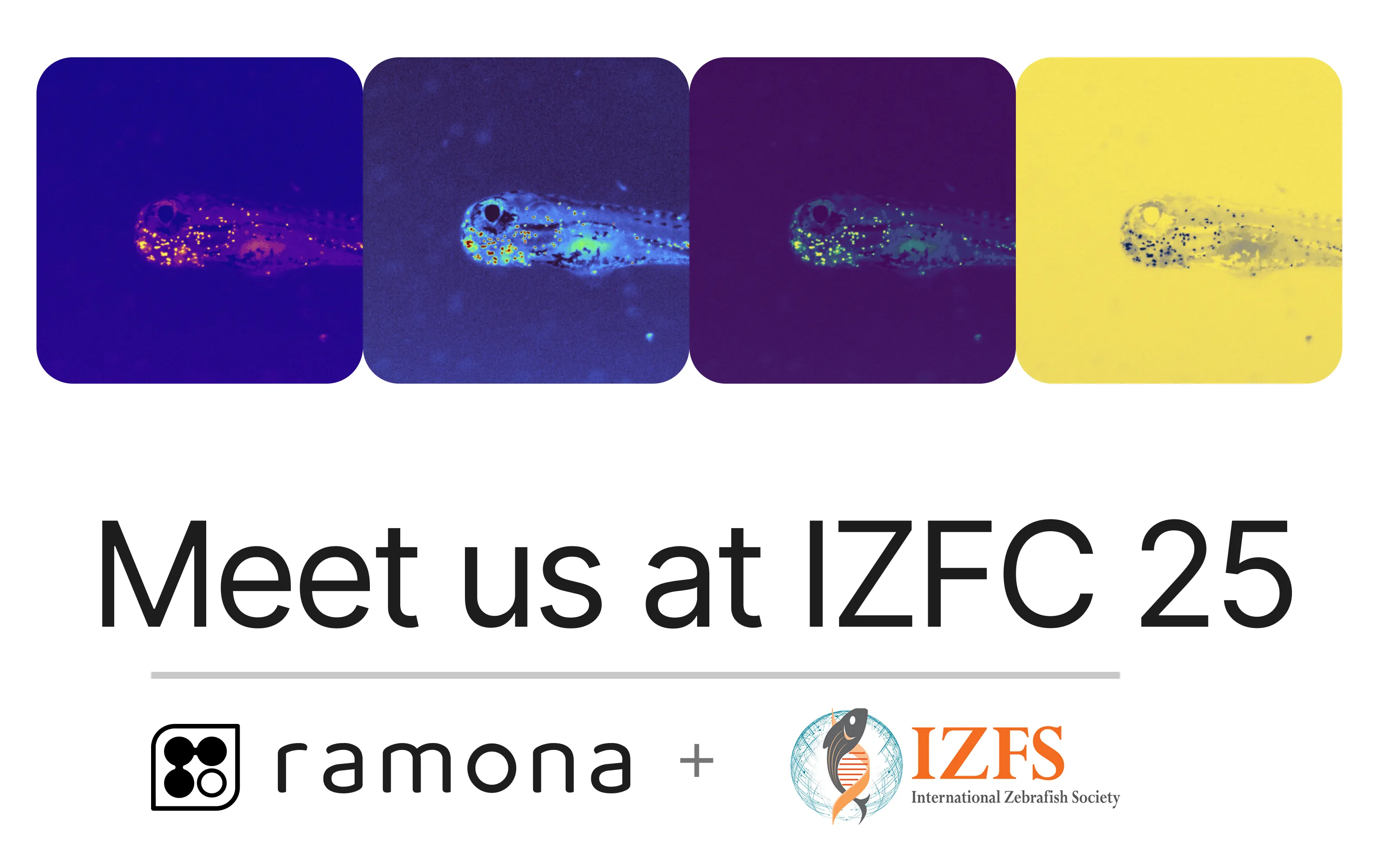
Ramona at IZFC 2025: Scale Up Zebrafish Discovery with the Kestrel™
